I saw a question bouncing around online recently asking readers for the most popular book they’d never read. It got me thinking about all the books I’ve loved that I would never have found on my own.
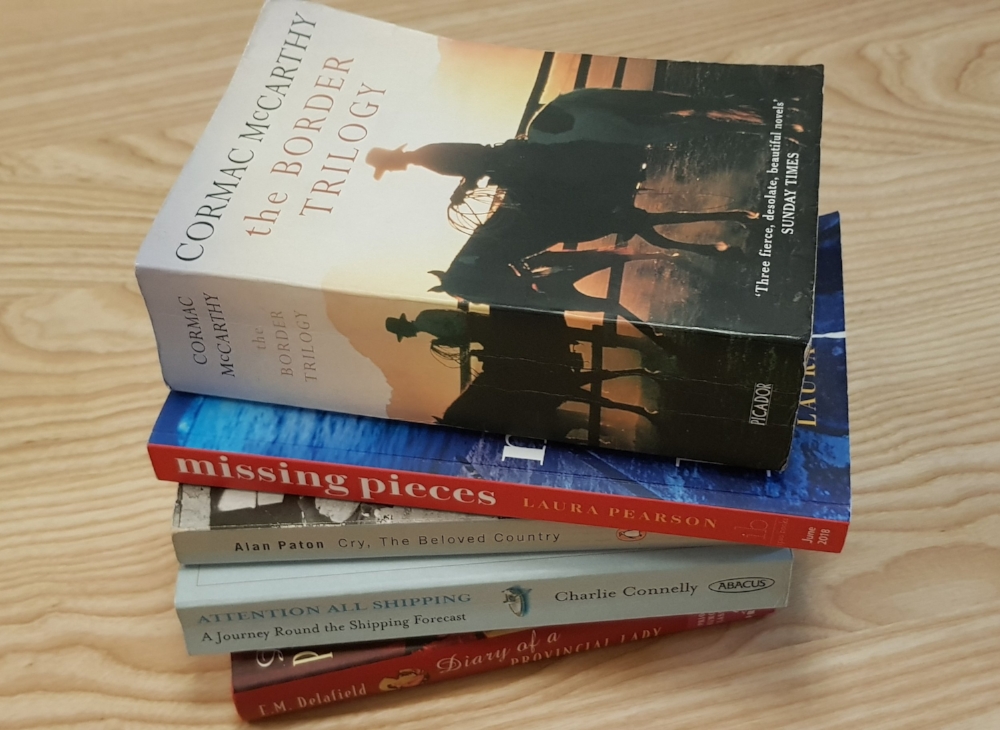
One of my greatest pleasures is sinking into something really special that I hadn’t been expecting so here are a few of those unexpected favourites that I needed a little nudge to discover.
My husband introduced me to Cry, The Beloved Country by Alan Paton while we were ‘negotiating’ how to merge our book collections. Published in 1948 it is set in a South Africa heading towards apartheid and follows Zulu Pastor Stephen Kumalo’s moving and affecting journey to find his son. Anti-apartheid protests had formed part of the backdrop to my school and student years but I hadn’t thought to read about through fiction. This book not only taught me more about South Africa and the circumstances which bred apartheid but is also a brilliant tale of love, hope and courage.
I hadn’t even heard of Cormac McCarthy when a librarian friend recommended All The Pretty Horses more than 20 years ago. It’s the tale of a young Texan rancher who has to leave his home and decides to head for Mexico. It’s part coming-of-age novel and part love story and absolutely stunning. I’ve never been more delighted to find out a book was the first of a trilogy. That friend also recommended the amazing Fugitive Pieces by Anne Michaels although I think I would have found my own way to that book.
The Affirmation by Christopher Priest was recommended to me as an example of a dual, or is it multiple, narrative story when I was trying to work out the dual narrative aspects of A Little Bird Told Me. At the time I wasn’t reading a great deal of Sci Fi or Fantasy; I find different styles and genres more or less appealing according to my mood or what else might be going on in real life. The Affirmation is described on Amazon as ‘at once a thriller and a haunting study of schizophrenia’ but it’s so much more than that. It’s possible to read the story on several levels, and the narrative curls and twists with a hypnotic quality. It stayed in my mind long after I’d finished as I toyed with differing interpretations of what really happened.
I was chatting with my hairdresser about books and she told me about Human Acts by Han Kang. When she said it was one of her favourite reads, I was intrigued. It’s set in South Korea and begins during the brutal suppression of the Gwangju uprising, a period of history I knew little about. The novel slips through different points of view and times to weave a lyrical and haunting tale of the trauma suffered not just during the atrocities themselves but how their impact lived on.
I heard about Missing Pieces by Laura Pearson through our shared publishers, Agora Books. I was worried that the family tragedy element would prove too heartbreaking for me but I armed myself with tissues and tea and then pretty much inhaled Laura’s gorgeous prose in two sittings. This is a beautifully written book that is full of honesty and humanity and, ultimately, hope.
There are so many more books that I could share that I’ve picked up in waiting rooms, read for a book club or had pressed upon me by another enthusiastic reader. Which books have you loved that you nearly didn’t read at all?
 Marianne Holmes
I love this twist on the "books you haven’t read" scenario, and you make all of these sound amazing.
Earlier this year my friend sent me Thomas Keneally’s A River Town, which she’d picked up at her dad’s house after he’d found it in a charity shop. I love the idea of books passing from hand to hand like this, and I wish we could do more of it in our overly cluttered world. It was my third Keneally (he’s written loads!), but while I admire him he’s never been top of my reading list, and it’s unlikely I’d have picked this up if it hadn’t been sent to me. Unlike his other works, I found myself immersed in a story of Irish immigrants coming up against religion and politics and finding their own way through the racist pecking order of nineteenth century small-town Australia – in ways that don’t always look too good to our 21st century gaze. I love books that open a window onto an experience I know nothing about, and Keneally did just that.
The fifth time we met, my boyfriend turned up at my flat with a copy of Star Maker by Olaf Stapledon. I’m a big sci-fi fan but there’s so much great contemporary stuff out there, I never seem to find time for the classics. I discovered a true mindbender of a story (one of my friends described it as a really slow, gentle acid trip): a putative history of the universe, as experienced by one human narrator. I love modern sci-fi because it’s constantly pushing boundaries and exploring ideas to do with race, gender and sociopolitical matters; with Star Maker, Stapledon pushed the boundaries of what narrative can do.
LikeLike
Thanks, Liz. Those both sound really interesting and I haven’t come across either before. They’re both now on my list – thank goodness it’s coming up for Christmas!
LikeLike